Saturday, April 20, 2013

Abhyasa - Perseverance (Words of the Master)

“Practice makes a man perfect” - This is true of Yoga studies as well.

In fact, the role of perseverance is pivotal here. Because after stalling the flow of one's biological and psychological energy, from getting dissipated in mundane objectives, one has to direct it to better purposes.

There is this great need for holding on to that first inspirational state, that arises within us occasionally, to pursue the path of self-improvement. We are apt to lose heart, when traveling this path of self-evolution. Long is the journey, and uncharted the path. It is therefore, that we are commended prolonged and uninterrupted effort. There is no sense of a spiritual life that proceeds by fits and bounds turns into a drudgery or is devoid of energy, strength, enthusiasm and cheerfulness.

For one thing, there is no question of hurry in spiritual matters. In the oft quoted story in the commentaries on Yoga Sutra: 

"The two tiny tittibha birds, that lost their eggs, to the sea, vowed to recover the same, is very apt. The birds began to gather drops of water in their beaks and flew a distance away dropping the sea water, with a hope that in this operation they would dry up the sea bed. They affirmed to themselves that though they knew very well, that their final objective may not be met in a few moments, or few hours, or even a few days, or a few weeks, or a few months or a few years, they were sure that if they persisted, birth after birth, they would succeed in the end. That was their determination and their source of enthusiasm. The impossible happened, as per the mythological story, when the divine Garuda intervened on their behalf, and recovered their lost eggs."

The efforts are not to be just for a little while.
Efforts are to be continued for a long time.
Much patience is needed here
.


"Patience is therefore also synonymous with the name of great yogis like Goraknath."

In traditional learning, there are to be asked no such questions:

"How long will I have to continue my studies?"

Sketch of Dr. Jayadeva Yogendra
President of The Yoga Institute of Santacruz
There can be no crash program in Yoga.

Another important point is that of not allowing any efforts to get lost. Once we create a certain climate, momentum and mood, we should keep up the tempo. The slightest distraction has to be avoided, lest the momentum might get interrupted.

It is often that the students of Yoga undertake tapa (severe discipline) to condition themselves for a serious and consistent study of Yoga. In this act of sadhana (spiritual study), the ritual of initiation has an emotive value. Spiritual journey could not be a dry and barren exercise, shorn of feelings of a positive kind.

Much can therefore be said of devotion, enthusiasm, cheerfulness and spiritual passion in this context. Before anything else, one has to pass through this positive experience.

This experience combines the will with the next important process of disinterestedness.

With regard to Yoga, faith and disinterestedness are the two sides of the same coin.

Source:
From "Stray Thoughts on the Yoga Sutras of Patanjali" by Dr. Jayadeva Yogendra, published by The Yoga Institute of Santacruz, Mumbai - India.

Wednesday, March 20, 2013

What is Classical Yoga or Traditional Yoga?

Understanding Yoga as on of the Indian systems of philosophy;
Understanding Yoga as a path for Self-realization;
Understanding Yoga as way of life;
Understanding Yoga in its entirety (not just taking one part of it).

All of the above is meant when we say Classical or Traditional Yoga.
Raja Yoga can also be called as Ashtanga Yoga or Patanjali Ashtanga Yoga.

So lets understand what is Raja Yoga or Patanjali Ashtanga Yoga in brief:

Raja literally means 'king' or 'royal'.
Raja Yoga may refer to one of the paths of Yoga amongst the 4 valid paths; the other 3 paths being Karma Yoga, Bhakti Yoga and Jnana Yoga.
But in reality it is the culmination of all Yogic disciplines and efforts. So Raja Yoga actually refers to the highest states of Yoga.

Patanjali, was a great sage who systematized the entire path of Yoga in his 195 sutras. And, in this way he has contributed to the human society this great work on spirituality and human psychology. Raja Yoga or Ashtanga Yoga consists of eight parts, often called as eight-limbs-of-yoga. Yoga traditionalist and scholars devote their entire lives in studying, learning and practicing the Yoga sutras of Patanjali.

Our beloved Guru Hansaji had once said to me that "the Yoga Sutras of Patanjali serve as a path for the humans to help themselves to come out of the turmoil of life".

It is a highly organized path, giving precise directions and guidelines to humans who are interested in spiritual and self-development.


So the eight disciplines of Ashtanga Yoga are:

1) Yama - Universal ethics; the don't(s) - five in total
2) Niyama - Personal observances; the do(s) - five in total
3) Asana - Physical postures

In a systematic and traditional path of Yoga, it is highly essential to place ethics and observances before physical postures. The first two steps empower a human to sublimate his negative tendencies, freeing the mind from many negativities. Then only, a deep awareness and control on the body can be gained. A total understanding over the body can be achieved when our thoughts, our behaviour, our entire lifestyle is pure. Otherwise, as our Gurus say "asanas will also become a materialistic way, to show off, to compete". Asanas will lose their deep spiritual purpose without the practice of Yamas and Niyamas.

4) Pranayama - Training of the bio-energy
5) Pratyahara - Sense withdrawal from sense objects
6) Dharana - Concentration
7) Dhyana - Meditation
8) Samadhi - Deep absorption in consciousness state.

To really understand Yoga, one has to experience it. It is an experiential science. It is a way of life, a very profound philosophy which needs to be put into application. It leads to an overall transformation of the human personality on all the planes.

Our entire Yoga Teacher Training course 200 hours and advanced 300 hours is based on Raja Yoga. It is a Classical Yoga training, with a traditional approach. 

All the techniques practiced in our center are scientifically taught. Here the students get to understand Yoga from the scratch, from its very roots. We get many students from different walks of life, some who have not practiced any Yoga, no yoga asanas. On the other hand, we also get so many students who had been doing Bikram Yoga, Hot Yoga, Ashtanga ‘Vinyasa’ Yoga, Power Yoga and such styles of physical practices. There are just so many styles. Today so many fancy names are put in front of Yoga.

But these are just some 'styles' of doing an exercise.
If it is not done with the right attitude, it is actually not 'Yoga'.
Even a style of asana has been now called as 'Ashtanga Yoga', but it is only an exercise style and many a times it can get confusing for a person who does not know the real meaning of Ashtanga Yoga. 

Yes, Yoga has a part called Asanas, which is important. But the other parts are equally important and cannot be neglected. A good routine, healthy food, natural environment, healthy inter-personal relationships, personal hygiene, daily exercises and body cleansing, breath work, meditation, and so many other things all make up Yoga. This is what we are committed to pursue and teach. In order to help yourself and to help others, we highly recommend that you choose to study and practice Yoga in its entirety. That would be Classical Yoga or Traditional Yoga :-)


--/--

Wise Living Yoga Academy is authorized to impart Yoga Teacher Training Courses on the tradition of The Yoga Institute of Santacruz in Mumbai, India – the world’s oldest organized Yoga Institution. The residential programs are held regularly in Bali (Indonesia), Chiang Mai (Thailand) & Minas Gerais (Brazil) throughout the year and are accredited by the Yoga Alliance USA, allowing the graduates to teach Yoga in any part of the world.

The 200 hours courses and the Advanced 300 & 500 hours Yoga Teacher Training Courses are conducted regularly in our new permanent Yoga Center in Doi Saket, Chiang Mai, Thailand.

Please follow the links to know more about all the scheduled
Yoga Teacher Training Courses (YTTC)  in 2013:


Sunday, March 10, 2013

Three Attitudes

Three attitudes prevent us from receiving a continual flow of blessings.
They are compared to three 'pots':

- a full pot,
- a pot with poison in it, and
- a pot with a hole in the bottom.

The pot that’s filled to the brim is like a mind full of opinions and preconceptions. We already know it all. We have so many fixed ideas that nothing new can affect us or cause us to question our assumptions.

The pot containing poison is like a mind that’s so cynical, critical, and judgmental that everything is poisoned by this harshness. It allows for no openness and no willingness to explore the teachings or anything else that challenges our righteous stance.

The pot with a hole is like a distracted mind: our body is present but we’re lost in thought. We’re so busy thinking about our dream vacation or what’s for dinner that we’re completely deaf to what’s being said.

Knowing how sad it is to receive blessings and not be able to benefit, Shantideva wants to save himself grief by remaining open and attentive. Nothing will improve, he says, unless we become more intelligent about cause and effect.

This is a message worth considering seriously!!!


From No Time to Lose: A Timely Guide to the Way of the Bodhisattva
Pages 83-84.

Monday, March 4, 2013

Yoga At Work

Besides conducting Yoga Teacher Training Courses in various parts of the world, we have long time ago introduced Corporate Yoga Training programs in India, and it has been a great experience.

We have introduced new methodology of training the employees by integrating modern activities and the concept of Multiple Intelligence and Experiential Learning.

These activities have been developed by The Yoga Institute of Santacruz and tested with thousand of students. They are used for bringing about more body awareness and control, concentration, relaxation and make it easier the understanding of the Yoga Philosophy – through conceptual games. All that, of course, along with traditional yoga asanas, pranayamas, kriyas and meditation.

Our aim is to use all this technology to give a broader perspective to physical and mental fitness, taking in consideration of the modern day set-up of an office environment and functioning.

Read more and go through the pictures below to understand how it works:

Kinesthetic Intelligence
Learning through movement and control of body. Developing better motor skills and neuro-muscular co-ordination. We have been using games and juggling with rubber balls which has show tremendous positive effect besides being a recreational activity.


Traditional Training with Yoga Asanas
The practice of asanas is the traditional method of improving body awareness and dexterity.


Training employees with Multiple Intelligence Techniques is a very practical exercise that promotes efficiency, decision power and harmonious inter-relations with other workers. It is shown highly beneficial for the progress of an organization.

Keep in touch to know more !!!
Namaskar !!!

Tuesday, February 26, 2013

Karma Yoga - Work with the right attitude

The emphasis is on the attitude and on consciousness. Maintaining a certain attitude constantly leads to a corresponding awareness which again leads to being established in this awareness at the time. That is why being involved in work is qualified by the statement “a right attitude”.

Work by itself is not what is suggested. To turn this work into worship will require change in the attitude. The usual suggestions here are faith, duty, service and concentration.

This immediately puts the mind in a different state. There is a worshipful attitude, dedication and much spiritual gain. In fact one who has reached such state and remains all the time in this state can very well claim the highest achievement for himself, i.e., self-actualization.

Do it - Why do we go on talking about right and wrong; good and evil? Newton talking about his work said it is 1% inspiration and 99% perspiration. Those who talk of right or wrong spend 99% in talking and 1% implementing. The Gita wants us to work 100% in the spirit of KARMA YOGA.

(This explanation above was a talk given by Smt. Hansaji (our Guru) in the Satsang (Spiritual gathering) at The Yoga Institute, Santacruz, India.)

Students working together with the spirit of Karma Yoga

In our Yoga Teacher Training Courses held in Thailand, Brazil and Bali we lay much importance on training  the students on the path of Karma Yoga. Especially the old students in our 300 hr Yoga Teacher Training Course get to learn in depth about this path by performing assigned tasks and duties with correct attitude (Bhavas) and with balanced state of mind. It is a valid path that can help a Yoga aspirant in his/her daily life by bringing a sense of joy, balance and content even in the ups and downs of life. It relieves a person from insecurity, stress, anxiety and depression. 

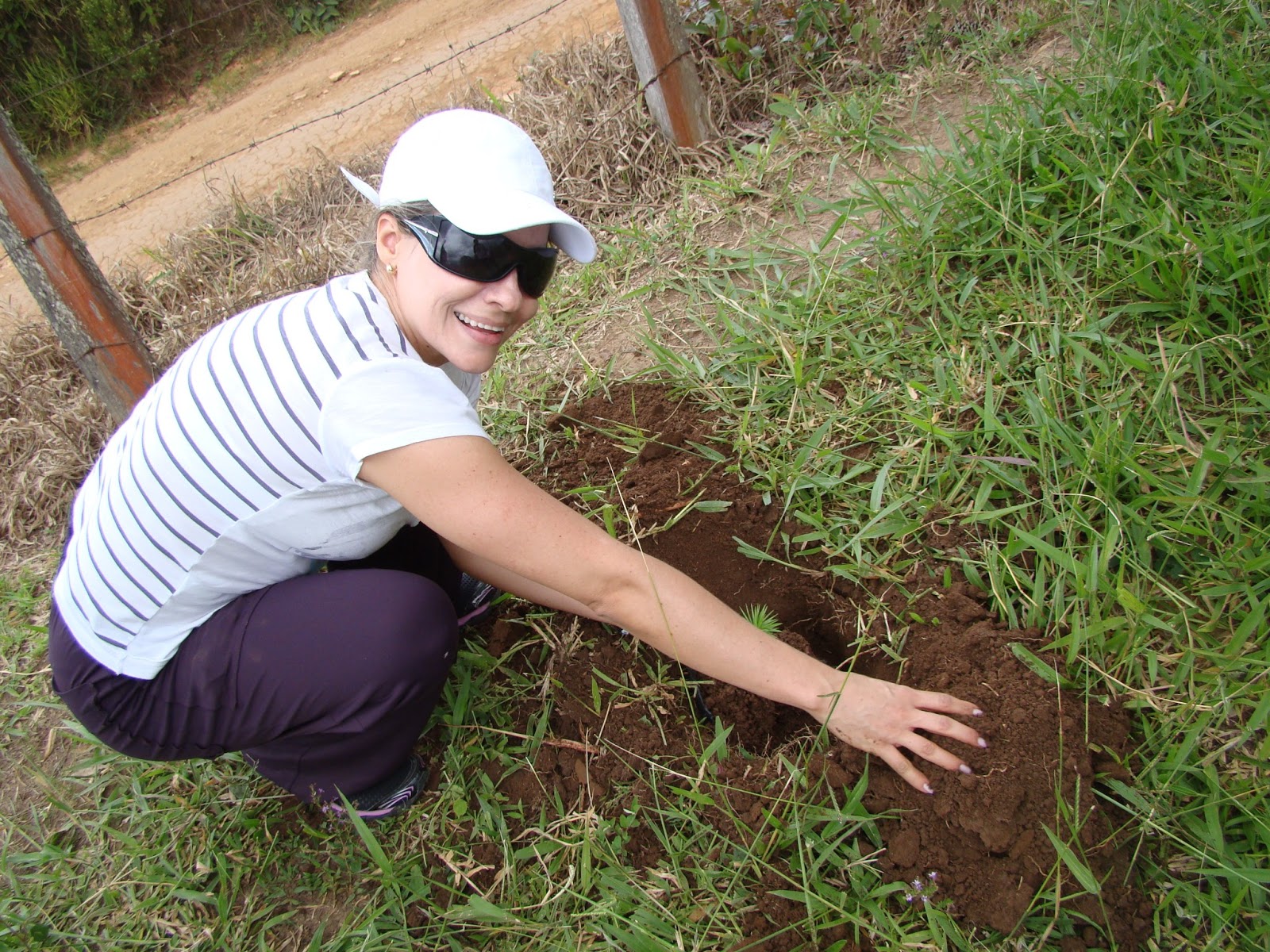
Ana digging a hole for planting a sapling

Students planting tree saplings

Karma Yoga during Yoga Teacher Training - Brazil

--/--

Wise Living Yoga Academy is authorized to impart Yoga Teacher Training Courses on the tradition of The Yoga Institute of Santacruz in Mumbai, India – the world’s oldest organized Yoga Institution. The residential programs are held regularly in Bali (Indonesia), Chiang Mai (Thailand) & Minas Gerais (Brazil) throughout the year and are accredited by the Yoga Alliance USA, allowing the graduates to teach Yoga in any part of the world.

The 200 hours courses and the Advanced 300 & 500 hours Yoga Teacher Training Courses are conducted regularly in our new permanent Yoga Center in Doi Saket, Chiang Mai, Thailand.

Please follow the links to know more about all the scheduled
Yoga Teacher Training Courses (YTTC)  in 2013:


Sunday, February 10, 2013

Yoga Teacher Training in Brazil/Brasil

Dear Yoga friends,

It is the 20th day of our Yoga Teacher Training Course, here in the lush green mountains of Brazil/Brasil. And everyday is a long day filled with mental and physical yoga techniques. The students are going through a deep transformation at all the levels of their personality. It is a profound experience, living here up on the mountains, meditating and practicing, listening to philosophy and eating a healthy diet. It is a wonderful challenge, to bring a powerful and long lasting change. And it is in process :-)

From left to right: Jeenal, Cindy, Alice, Maria, Karine, Mariana, Damian & Daniel
Sitting: Luciana, Marli and Ana

All the participants have finished with their Yoga lesson plans and presentations. They have also experienced taking a 20 mins yogic relaxation class. Yesterday, Damian was the last but not the least to conduct his class on relaxation techniques. His words flowed like a soothing river, with so much serenity, with many colors and emotions, and everyone felt at ease. When a students find solace and satisfaction in sharing their deep expressions of the very essence of their being, I feel so much at peace and my trust and love in spreading this higher education of life grows even more. I felt gratitude, and I asked him "Do you feel content?"

It is a nice feeling, of peace, of kindness, when we know that we can be of help to someone. When we can make others smile, when we can uplift someones life. And this is YOGA!

Damian concluded the class with a sweet poem on Yoga, which I would like to share here:

Blossoming -
by Janet Arnold-Grych from The Poetry of Yoga Volume 2 (page 41)

In the beginning,
With each unraveling of the mat,
We are anxious to add to our garden,
To gather the beautiful buds,
And coax each asana to open quickly.
Feet in the dirt we stand,
Sometimes for the first time,
Connecting earth to muscle and muscle to sky,
The energy of an immense lineage
Pulsing with promise.
But as the poses settle,
As we settle,
We find that yoga’s true gift is not about more
But less.
The outline of the poses remain the same.
Yet when the space between is fed,
When ease replaces expectation,
When patience replaces petals,
We find that the asanas are no longer
About holding on,
But letting go.
And in that release,
Without judgment or force to impede,
Breath floods in,
Releasing the mind and freeing the heart.
Through yoga,
We find
That core of serene nothingness,
And learn that in letting go,
We gain everything.

What a beautiful poem, indeed! Isn't it?

We wish all our students the very best for their Yoga exam which is coming soon. But life itself is a test, and our best wishes will always remain with them. All our students are so special for us. Thank you so much everyone of you!

Namaste! OM Shanti!
Jeenal

Thursday, January 24, 2013

Growing Old Gracefully

We see certain changes happening in our own person.

The body grows from infant stage to the next stage where there is a complete change in the external appearance. The infant grows into a youth. So totally dissimilar! It is this feeling (that it is still myself) that is important for us. Even if we get completely disfigured, the feeling does not disappear. In a way the feeling is connected with our consciousness. We are aware that we exist. That's the only reality.

The man in the intensive care unit, breathing his last breath, also has the same feeling of self. Had he not become panicky, this awareness could extend to the awareness without the body. In our worldly confusion, nothing else exists for us except the immediate. We are too concerned with our possessions, with our image and our physical existence.


Whenever external changes occur, we are panicky. Growing up is a matter of great emotional trauma for a little infant as it is for the adolescent. It turns out to be a battle of wits for the very capable young person to occupy a senior position ousting the earlier incumbent. The old man does not want to give up and the young man is in a mood to take over. The individual recognizes his total incapacity, physical and mental; yet he is unwilling to give up.

Sankaracharya very nicely depicted this state in a verse: 'The old man’s head is now white with grey hair, all the teeth have gone. The old man walks with a stick for support still the desire to continue to live does not leave him.'

We have to recognize changes that occur, accept the ones that cannot be changed and still maintain our own peace and carry on what we have to do as our duty.

Actually at the highest level the individual becomes so philosophical that he realizes the changes that occur in life; like a Buddha he can see that we are all like the mute sheep that are driven to a slaughter house. We do not recognize the change that comes at the end. Buddha did accept it when he wondered in the end as to how long his rattling body will continue. 

Hansaji Jayadeva Yogendra

This article was published in Yoga & Total Health (October 2012) - the monthly magazine of The Yoga Institute.