Showing posts with label Concentration. Show all posts

Sunday, September 29, 2013

Yoga Education - Part 2

How does one select the right type of Asanas?

The Yogi borrowed heavily from Nature because of his proximity to forests, mountains and caves. However he was judicious in his selection. He preferred to learn from the relaxed crocodile rather than from the rabbit or the inquisitive dog (although these postures are there in Yoga nowadays). He imitated certain birds, animals and natural objects. The selection of  postures (Asanas) was based on an overall approach to the physical, mental and moral well-being of an individual.

Methods

The Asana practices were carried on for a longer duration. This provided a chance for prolonged mental participation, synchronization and direction. Thinking precedes action and unless the mind is well under control, merely developing the body may later weaken it. The Yogis therefore took into account the psychological aspect of our personalities. The well-known physiologist Matveyev said: “The Yogis demonstrate pronounced endeavour to consciously direct the activity of certain organs, even of certain glands and internal secretions and maintain that they scored along the line.

Right and Wrong Directions

Talasana or Palm Tree Pose
(focus on the synchronization of
breath and movement)
With the practice of the third step, the Asanas, we overcome unsteadiness, inertia and other impurities. We might even perfect the steadfastness (Siddhi) that involves the mind even further (Samapatti) but this is an exception. We must not aim at too many things at the start.  In fact, each step of the Eight-fold Path (Ashtanga) has only a certain strength to impart.

All that we should concern ourselves with, during the Asana practice, is imparting a wider meaning to our activity. The act of breathing is a good aid in holding our attention. Also directing our mind to different parts of the body. Synchronization of breathing with movements of the body during the practice of Asana in a fixed measure was introduced by Shri Yogendraji in 1917 and is now popular among many Yoga teachers and schools.

There is, in fact, much to learn from Asanas.  However, a practitioner must possess:

(i) a strong commitment,
(ii) a disciplined mind,
(iii) introversion and tranquility when one begins the Asana practice, and
(iv) synchronization of breathing.

If one has achieved the above conditions, one will succeed in uplifting one’s thoughts to a higher level of consciousness.

Steadiness

We have just discussed that steadiness is vital to the performance of an Asana. How do we achieve this steadiness? Secure the feet correctly, sit upright, have a good base (Sthirata), avoid hurry, agitation and speed. Cultivate solemnity, commitment, decisiveness, etc. To remain for a certain length of time without agitation is in itself an achievement.

The next step is the achievement of relaxation while carrying out conscious movements. You will ultimately reach a state of profundity or the so called “let go” sensation. Full composure and control is necessary. One must not collapse into a final position. One must consciously seek out areas of relaxation – some sensitive zones in the body.

Matsyasana or Fish Pose
(focus on relaxation through awareness of
the movements of the abdomen while breathing)

Relaxation

The state of relaxation is very valuable in therapy. Coordinated breathing aids in bringing the mind to this state. Otherwise, the chances are that the mind strays away from the Asana into other areas. You must lead your mind to areas such as the abdomen in Matsyasana (Fish Pose) and create the sensation of “let go”, or the chest in Talasana (Palm Tree Pose). This directing of attention and concentration on breathing will achieve a good deal of relaxation. These poses are many other Yogic techniques are very well examined during our Yoga Certification Course in Thailand.

When one works systematically one experiences a change in one’s thoughts, behavior, action etc. Usually these conditions come in a flash and are lost. There are usually so many external distractions and constraints that restrain a person from achieving relaxation.  In Yogic Asanas you are with yourself and can perfect these attitudes by self-training. In the end you can achieve a perennial state of stability (Ananta Samapatti). 

The postures you do every day need not be very difficult, but your attitude while doing the postures must be sustained. You should thus understand the deeper significance of the Yoga postural training: steadiness (Sthira) and contemplation on fixity (Anantasamapattibhyam).

Photos: taken on location - The Yoga Institute of Santacruz, India. Daniel Fonseca performs two simple, but effective, postures advocated by Shri Yogendraji for a daily course of Yoga postural training.

Source:
Excerpts of the book Yoga and Total Health in Schools - published by The Yoga Institute of Santacruz.

Wednesday, March 20, 2013

What is Classical Yoga or Traditional Yoga?

Understanding Yoga as on of the Indian systems of philosophy;
Understanding Yoga as a path for Self-realization;
Understanding Yoga as way of life;
Understanding Yoga in its entirety (not just taking one part of it).

All of the above is meant when we say Classical or Traditional Yoga.
Raja Yoga can also be called as Ashtanga Yoga or Patanjali Ashtanga Yoga.

So lets understand what is Raja Yoga or Patanjali Ashtanga Yoga in brief:

Raja literally means 'king' or 'royal'.
Raja Yoga may refer to one of the paths of Yoga amongst the 4 valid paths; the other 3 paths being Karma Yoga, Bhakti Yoga and Jnana Yoga.
But in reality it is the culmination of all Yogic disciplines and efforts. So Raja Yoga actually refers to the highest states of Yoga.

Patanjali, was a great sage who systematized the entire path of Yoga in his 195 sutras. And, in this way he has contributed to the human society this great work on spirituality and human psychology. Raja Yoga or Ashtanga Yoga consists of eight parts, often called as eight-limbs-of-yoga. Yoga traditionalist and scholars devote their entire lives in studying, learning and practicing the Yoga sutras of Patanjali.

Our beloved Guru Hansaji had once said to me that "the Yoga Sutras of Patanjali serve as a path for the humans to help themselves to come out of the turmoil of life".

It is a highly organized path, giving precise directions and guidelines to humans who are interested in spiritual and self-development.


So the eight disciplines of Ashtanga Yoga are:

1) Yama - Universal ethics; the don't(s) - five in total
2) Niyama - Personal observances; the do(s) - five in total
3) Asana - Physical postures

In a systematic and traditional path of Yoga, it is highly essential to place ethics and observances before physical postures. The first two steps empower a human to sublimate his negative tendencies, freeing the mind from many negativities. Then only, a deep awareness and control on the body can be gained. A total understanding over the body can be achieved when our thoughts, our behaviour, our entire lifestyle is pure. Otherwise, as our Gurus say "asanas will also become a materialistic way, to show off, to compete". Asanas will lose their deep spiritual purpose without the practice of Yamas and Niyamas.

4) Pranayama - Training of the bio-energy
5) Pratyahara - Sense withdrawal from sense objects
6) Dharana - Concentration
7) Dhyana - Meditation
8) Samadhi - Deep absorption in consciousness state.

To really understand Yoga, one has to experience it. It is an experiential science. It is a way of life, a very profound philosophy which needs to be put into application. It leads to an overall transformation of the human personality on all the planes.

Our entire Yoga Teacher Training course 200 hours and advanced 300 hours is based on Raja Yoga. It is a Classical Yoga training, with a traditional approach. 

All the techniques practiced in our center are scientifically taught. Here the students get to understand Yoga from the scratch, from its very roots. We get many students from different walks of life, some who have not practiced any Yoga, no yoga asanas. On the other hand, we also get so many students who had been doing Bikram Yoga, Hot Yoga, Ashtanga ‘Vinyasa’ Yoga, Power Yoga and such styles of physical practices. There are just so many styles. Today so many fancy names are put in front of Yoga.

But these are just some 'styles' of doing an exercise.
If it is not done with the right attitude, it is actually not 'Yoga'.
Even a style of asana has been now called as 'Ashtanga Yoga', but it is only an exercise style and many a times it can get confusing for a person who does not know the real meaning of Ashtanga Yoga. 

Yes, Yoga has a part called Asanas, which is important. But the other parts are equally important and cannot be neglected. A good routine, healthy food, natural environment, healthy inter-personal relationships, personal hygiene, daily exercises and body cleansing, breath work, meditation, and so many other things all make up Yoga. This is what we are committed to pursue and teach. In order to help yourself and to help others, we highly recommend that you choose to study and practice Yoga in its entirety. That would be Classical Yoga or Traditional Yoga :-)


--/--

Wise Living Yoga Academy is authorized to impart Yoga Teacher Training Courses on the tradition of The Yoga Institute of Santacruz in Mumbai, India – the world’s oldest organized Yoga Institution. The residential programs are held regularly in Bali (Indonesia), Chiang Mai (Thailand) & Minas Gerais (Brazil) throughout the year and are accredited by the Yoga Alliance USA, allowing the graduates to teach Yoga in any part of the world.

The 200 hours courses and the Advanced 300 & 500 hours Yoga Teacher Training Courses are conducted regularly in our new permanent Yoga Center in Doi Saket, Chiang Mai, Thailand.

Please follow the links to know more about all the scheduled
Yoga Teacher Training Courses (YTTC)  in 2013:


Sunday, March 10, 2013

Three Attitudes

Three attitudes prevent us from receiving a continual flow of blessings.
They are compared to three 'pots':

- a full pot,
- a pot with poison in it, and
- a pot with a hole in the bottom.

The pot that’s filled to the brim is like a mind full of opinions and preconceptions. We already know it all. We have so many fixed ideas that nothing new can affect us or cause us to question our assumptions.

The pot containing poison is like a mind that’s so cynical, critical, and judgmental that everything is poisoned by this harshness. It allows for no openness and no willingness to explore the teachings or anything else that challenges our righteous stance.

The pot with a hole is like a distracted mind: our body is present but we’re lost in thought. We’re so busy thinking about our dream vacation or what’s for dinner that we’re completely deaf to what’s being said.

Knowing how sad it is to receive blessings and not be able to benefit, Shantideva wants to save himself grief by remaining open and attentive. Nothing will improve, he says, unless we become more intelligent about cause and effect.

This is a message worth considering seriously!!!


From No Time to Lose: A Timely Guide to the Way of the Bodhisattva
Pages 83-84.

Tuesday, September 11, 2012

Yogic Relaxation - Shavasana for Stress Management.

"A significant number young adults are showing adverse effects of stress on their physical and mental health that result in emotional disturbances, faulty eating habits and overall lifestyle disorders. Long term stress is also the cause of several diseases along with personal and family problems."

Yogic techniques for relaxation are very practical techniques to restore balance and rejuvenate the body and mind. Shavasana which is a conscious relaxation technique which is done by relaxing each and every body part, one by one, and it can be done in a time span of 20 to 40 minutes.

There are so many stressful moments that we have to face daily. Catching a flight, taking an important decision, managing the finance and with such other responsibility we often feel drained and dry. Along with these wrong eating habits, inadequate rest, faulty time management, lack of physical exercise can enhance the stress. In this way we start to accumulate negativity over a period of time. Therefore it is very important to release this negative energy on regular basis and replace it with positive energy. The reason we often feel depressed, lazy, confused and fatigue is that we haven’t learnt to relax.

The concept of relaxation is highly misunderstood. We may think that watching T.V or just lying in the couch is a form of relaxation, but it doesn’t really help you to ease and loosen your contracted muscles, neither it’s a form of a conscious relaxation that will calm down your breathing and cool down your mind. May be it can help you to some extent but when you relax with Shavasana you are actually messaging your mind to get inwards and consciously feel your body and release the stress from each and every body part.


With my own experience I can say that whenever I have given this technique to my clients, it has shown tremendous results in their health and behaviour. Serious problems like insomnia, migraine, blood pressure, diabetes, anxiety and asthma have all got under control. Other complaints like headaches, muscular tension, and back pain have got cured. After Shavasana my clients have reported that they feel healthy and completely fresh and full of life. I strongly recommend this technique for all the working professional on regular basis.

In the beginning the client will need the support of the trainer for at least one month. For the beginners it is essential that the trainer gives them complete instructions verbally during the practice every time they practice Shavasana. It is normal that initially a person would not be able to relax because of the accumulated stress, but with the practice the technique will get easier.

It also possible that the person may fall asleep during the instructions, which is not the ideal. This can happen a few times when the person has not completed his sleep. But with gradual practice, a person will start to feel more and more calm, confident, happier and relaxed. This will bring a positive change in the personality and increase memory, concentration, decision power and emotional stability. Erratic eating habits, anger, fear and other negative traits will also get under controlled. It can also be easily done at office premises after lunch or at the end of the day!


Post by: Jeenal Mehta & Daniel Fonseca, co-founders of Wise Living Yoga Academy which is authorized to impart Yoga Teacher Training Courses on the tradition of The Yoga Institute of Santacruz in Mumbai, India – the world’s oldest organized Yoga Institution. The residential programs are held regularly in Bali (Indonesia), Chiang Mai (Thailand) & Minas Gearais (Brazil) throughout the year and are accredited by the Yoga Alliance at the 200 hours level, allowing the graduates to teach Yoga in any part of the world.

Please follow the links to know more about our YTT courses 200 hours in 2012/2013:

Sunday, August 26, 2012

Going Back to.. Traditional Yoga

Millions of people head towards Asia every year to have (besides the travelling experience) an encounter with eastern philosophies and practices which allows for self-healing, self-discovery and self-empowerment. Among alternative medicine systems, therapies, and many other technical systems (including massage, martial arts, dances, etc, etc) one of the famous and inspiring subjects that attract people to Asia is Yoga.


Although most people think, or like to think, of Yoga as a physical system, in reality it is an ancient and traditional system of Indian Philosophy and Disciplines that emphasizes on a holistic way of living which allows for a deep transformation, awareness and positive changes, not only on the physical, but also on the mental, social and spiritual planes of the human personality.


Traditionally, Asanas (postural training) is only one part of Yoga. Certain sets of conduct regulations (Yamas) and observances (Niyamas) throughout one’s own life form the very foundation of Yoga. Only then follows Asanas. The next step being control of bio-energy through breathing techniques (Pranayamas). Eventually withdrawal of senses (Pratyahara) will be achieved. Following stages are concentration (Dharana), meditation (Dhyana) and finally leading to total absorption in pure consciousness state (Samadhi). This is the goal of Yoga.


The stages described above are known as the “Eight-fold Path of Yoga” and the understanding of these disciplines and the systematic implementation of them in one’s own life is what is meant by “Classical Yoga”. The problem is that Yoga is becoming too much commercial and many teacher and so called “Yogis” have very little or no understanding of the Yoga path in its entirety.


Yoga has become just a matter of performing some “stunt moves” on a rubber mat. But, the truth is that, even for the physical training, if the right attitude and feelings are not present then the Yoga exercises will be just like any other exercise. It will, of course, bring benefits to the practitioner, but that will be only partial, not the real life transforming experience that one may be looking for. As we have seen, more and more, people are realizing this, and there is somehow, a search and an interest for going back to Traditional Yoga.


The first question is: where to go to learn Traditional Yoga? The most obvious answer would be: “India”. But nowadays even in India, commercial Yoga has taken over, and you can meet with either a good or a bad teacher or school, in India, or in any other Asian country. Literally thousands of workshops, retreats and teacher training courses are being offered throughout South East Asia, in countries like Thailand. And for one desiring to have an authentic Yoga experience (instead of just learning some acrobatic postures here and there) a good amount of research is necessary, before choosing a teacher or a course.


And which type of course? Well, the best way to absorb Yoga is to make it a part of one’s own life and then sharing it with others and teaching. That’s why more and more people are looking for Yoga Teacher Training Courses, because, besides being provided with the learning experience, at the end, one can be qualified and certified as a Yoga Teacher.

For this kind of program, the advice would be:

First, one should not undertake such a program only with the certification in mind, but to take it with a sincere interest in self-development and motivated by an altruistic desire to help one and others. Second, luxurious retreats usually divert the focus from the Yoga objectives, not serving the real purpose of simple, ecological and modest lifestyle which is in the core of Yoga. Then, choosing a school which follows a genuine Yoga lineage which upholds the traditional values of Yoga. Be aware of self-proclaimed gurus & too many mixture and fusions of “Yoga styles”.

Finally, if the program is a full immersion experience, that should enable one to live a yogic and holistic lifestyle which means, having a residential course, following a well structured routine including healthy diet arrangements and encouraging a meditative mood. Further, it should include a serious study of traditional Yoga texts like “Yoga Sutras of Patanjali” and “Bhagavad Gita”. Practice and theory should go hand in hand. Of course the curriculum should also include anatomy & physiology classes, methodology and teaching practice.


But one thing is for sure, a Yoga course, especially if it’s a Teacher Training, which only teaches Asanas, and does not encourage a yogic lifestyle (having a good routine, vegetarian diet, abstaining from intoxicants - for at least 1 month period) and does not include the study of the Yoga philosophy, is certainly not imparting authentic Yoga. In here I would quote Leonardo da Vinci who said:

He who loves practice without theory is like the sailor who boards ship without a rudder and compass and never knows where he may cast.

So, if you are travelling throughout South East Asia don’t miss the opportunity to find a good Yoga course and perhaps even return home certified and a Yoga Teacher.


This article was written, to be published at the South East Asia Backpacker Magazine, by Jeenal Mehta & Daniel Fonseca, co-founders of Wise Living Yoga Academy which is authorized to impart Yoga Teacher Training Courses on the tradition of The Yoga Institute of Santacruz in Mumbai, India – the world’s oldest organized Yoga Institution. The residential programs are held regularly in Bali (Indonesia) & Chiang Mai (Thailand) throughout the year and are accredited by the Yoga Alliance at the 200 hours level, allowing the graduates to teach Yoga in any part of the world.

Please follow the links to know more about our YTT courses 200 hours in 2012/2013:


Thursday, March 8, 2012

Fundamentals of Yoga Education in Teacher Training

Experience a healthy lifestyle during our YTT course!

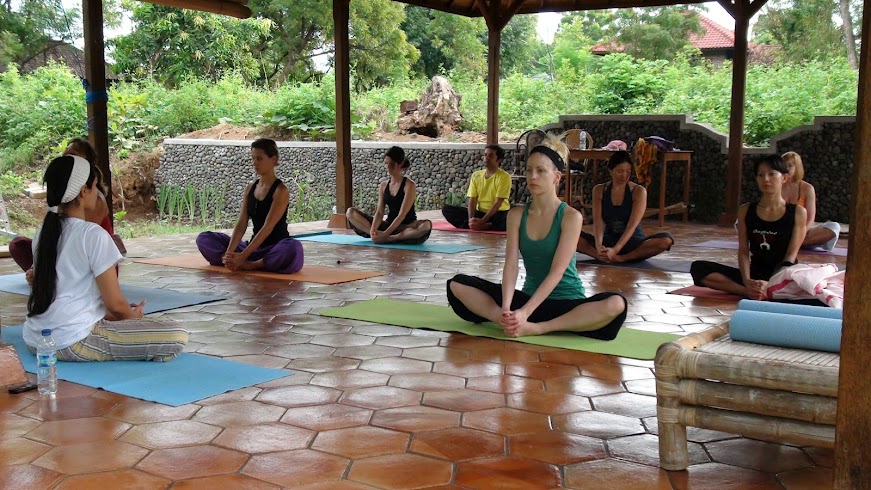
Participants doing morning meditation!
Morning Asana class

Our Yoga teacher training programs apart from guiding an individual to become a Yoga Teacher serves other purpose too.  A very good benefit of our Yoga course that is being held in Thailand and Bali is that the people will really experience living a Yogic Lifestyle. A healthy routine involving in waking up early and experiencing deep silence through meditation. Doing Yoga Asanas, breathing excercises will help to detoxify, rejuvenate and give a sense of well-being to you.Then, a healthy breakfast which is often neglected by many of us will help to balance your bodily requirements.

Our Yoga course is a blend of discipline, fun, relaxation and recreation :-)

Participants out for a trekking!
Next benefit is that the Yoga Teacher Training course emphasizes on self-awareness and self-discipline by giving you time limits to accomplish your personal tasks. After breakfast you have 2 hours for your personal care and study. Apart from this there is time for recreation where you have a chance to the connect to yourself and relax. On Saturday you have free time after lunch and a full day off on Sundays. On these days you can do recreational activities visiting cultural places, relaxing on the beach, morning walks etc. Yogic Relaxation will be also systematically taught and the participants will go through the process of Yogic Relaxation after lunch for efficient digestion, detoxification and rejuveanation. This will relieve them from nervous tension and calm the mind and body. Yogic relaxation is a very powerful and deep technique to bring a deep & positive change in the human personality.

During the Yogic Relaxation class

Yoga learnt through experiential learning!


Daniel teaching Bhagvad Gita in the green!
Study, Share & learn Yoga!

Our Yoga teacher training emphasizes on Yoga philosophy as well, which can help you to look at life with a broader perspective and encourage you to challenge your weaknesses. You will get the opportunity to learn Sanskrit words and meaning of it. You will be learning so many different aspects of life and Yoga that will help you to look deeper into your self and help you to discover your inner potentials!

Philosophy class with Jeenal

Healthy food habits is a part of Yoga!

A photo of a healthy
breakfast served in the YTT, Chiang Mai
in Thailand
Of course, food is something that can really make us feel healthy or sick. But here we will eat healthy varieties of food at proper time, and dinner will be around 6.30 in the evening as we will be going to bed early. Everyday we will be having varieties of fruits, vegetables, cereals and dairy products at regular timings and intervals. This will nourish and replenish the body with different vitamins! And having a discplined routine harmonise the biological clock of the body. It is like having a new life!

A deep positive transformation is the aim of our Yoga Teacher Training!

Conceptual activities class!
Learning different cleansing techniques, practicing Asanas, studying philosophy, connecting back to nature, everyday meditation, breathing teachniques and relaxation techiniques will bring tranquility and clarity in your physical and mental levels. This is one of the aim of our Yoga Teacher Training. Then one can experience the joy of being free from inhibitions, stress and pressures of a fast life.

Out in the nature for recreation!

Discovering a new path of life & sharing the knowledge with others!

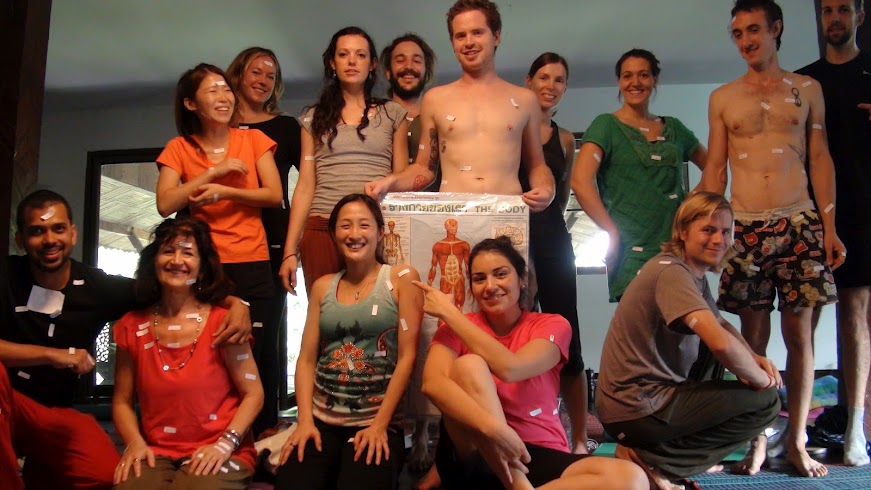
Yoga Teacher Training group in Brazil
You will be learning to impart this knowledge to various groups of the people in the Yoga methodology class. The greatest benefit for many will be when they realize that they want to bring this spritiual and hoilistic education for other people around them. With all this knowledge of Yoga, you can go ahead to help and uplift people's lives. The postive change that you have experienced will be worth sharing with other people. There are so many different people like senior citizens, teenagers, parents, children, people with health problems, corporates and proffessionals, householders etc. that you can help.

Your teachers - A beautiful couple dedicated to Yoga :-)

Jeenal and Daniel is a lovely couple from India with whom you can share, and they are open to share their experiences about their yoga life. They have an in-depth knowledge and expertise in Yoga are experienced Yoga teachers from India. They have spent 5 years living, learning and teaching Yoga with their Yoga Gurus from India. They have trained hundereds of students till now. To know what their students say about them, please click on this link : Testimonials.

Daniel teaching Pranayamas
 in a Teacher Training course in Chiang Mai


Jeenal and Daniel in the mountains of Mantiqueira of Brazil

They have trained hundreds of students in Teacher Training course from various countries coming from different backgrouds and of different age group. They will be the main teachers guiding the group and staying along with the participants. Jeenal is a blend of western and Indian culture. She is an Indian woman who grew up in a traditional Indian family with Yogic values while studying in an International school. And, Daniel was born in Brazil in a brazilian family. He grew up doing various martial arts, adventurous activities such as mountain biking and diving. He lived in United Kingdom and Europe before arriving to India to learn Yoga. Now he is living in India since 2006 and both of them travel worldwide to teach Yoga. In 2006 Jeenal and Daniel met the Yoga Institute of India and ever since that they have dedicated their life studying and sharing Yoga with others.


Jeenal teaching Yoga Sutras in a course in Brazil

The Wise Living Yoga Academy Team invites you to join their Yoga Teacher Training to experience this beautiful journey of positive transformation, of self discovery, of self love and spiritual realisation!

Yoga Teacher Training Certification day
in Chiang Mai, Thailand - July


The course is recognized by The International Board of Yoga, The Yoga Institute - India which is the worlds oldest Yoga Organisation and accredited by Yoga Alliance - USA (RYS-200 Level)Please follow the links to know more about our YTT course 200 hours in 2012:-

Namaskar,
Wise Living Yoga Academy Team

Friday, December 23, 2011

The True Spirit of Christmas

The good man brings good things out of the good stored up in his heart, and the evil man brings evil things out of the evil stored up in his heart. For out of the overflow of his heart his mouth speaks.

In the end of December of every year most of the western world and also many people in the east celebrate the birth of an exceptional man called Jesus the Christ.

This great man is what in the Vedic culture is known by an Avatar or an earthly incarnation of God. And a man who can be called a God is a man who exhibits exceptional qualities and virtues of the human species such as being humane, kind, considerate, understanding, sympathetic, tolerant, approachable, accessible, compassionate, selfless and who ultimately is able to sacrifice himself for the sake of others.

“Do unto others as you would have them do unto you.”

God descends from his celestial plane and take human form to teach people by example of behaviour what is expect of  the other men (and of course the women) - in other words, what is expected of the human race as a species. The true followers of such God-Man are those who make all efforts to apply such behaviour and conduct in his daily life, and in such a way, practice his ways towards divinity themselves.

This is the true spirit of Christmas: to follow in essence the teachings of the Christ or to consciously copy his behaviour making his one’s own.

Those who make undue use of commerce, display luxury in manners of dressing & eating and indulge in intoxication of the body and mind are in no ways celebrating Christmas or the birth of Christ or his teachings.

For everyone who exalts himself will be humbled, and he who humbles himself will be exalted.

Christmas is time for penance - but not in the sense of self-punishment or mortification - but in the sense of modesty, simplicity and ascetic austerity which allows to introspection and meditation.

These are the essential attributes that will allow the awakening of the divinity sought within.

Greater is He that is in you, than he that is in the world.' I John 4:4”

Let us imbue the true spirit of Christmas in these days of celebration!
Wishing you a Merry Christmas & Happy New Year!

Daniel & Jeenal

Tuesday, May 10, 2011

Vipassana Meditation

Namaste friends & Yoga enthusiasts.. I'm posting again a article from our old blog which I  wrote originally in November 2008. I talked today to a friend who is going to Vipassana for the first time.. so I thought about sharing this once again. There you go:

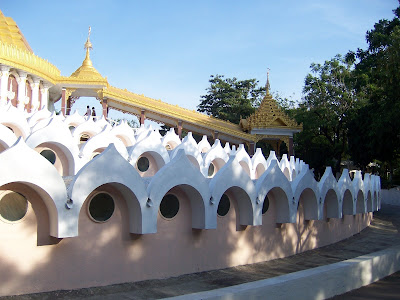
Hi guys.. I have just come back from my second 10 days Vipassana Meditation course, in Dhamma Giri, the headquarters of Vipassana International Academy in Igatpuri, and would like to share with you about this experience. Have a look at the pictures from Dhamma Giri complex. (Pictures of the Meditation Halls are not allowed.)

For those who don’t know, Vipassana is a technique of Meditation taught in ancient times by Gautama 'the Buddha' himself, and preserved (in Burma) in its pristine form by a long line of teachers descended directly from the Buddha and it was brought back to India by S.N. Goenka, or Goenkaji as he is widely and respectfully referred to.

The technique involves the following observances and practices: Sila (morality), Samadhi (concentration) and Panna (wisdom).

And for those who think meditation is an easy job… that you just need to sit cross-legged and do nothing… you will be surprised to know that Vipassana Meditation is a hard work and that the 10 days course calls for a lot of effort and discipline.
In Goenkaji’s own words, one has to “work diligently, ardently, persistently, patiently but continuously, observing sensations throughout the body and remaining equanimous, understanding the technique properly, purifying the mind, to work out one’s own liberation from misery”.

More about the Technique

The technique of Vipassana is a simple, practical way to achieve real peace of mind and to lead a happy, useful life. Vipassana means "to see things as they really are"; it is a logical process of mental purification through self-observation.

From time to time, we all experience agitation, frustration and disharmony. When we suffer, we do not keep our misery limited to ourselves; instead, we keep distributing it to others. Certainly this is not a proper way to live. We all long to live at peace within ourselves, and with those around us. After all, human beings are social beings: we have to live and interact with others. How, then, can we live peacefully? How can we remain harmonious ourselves, and maintain peace and harmony around us?

Vipassana enables us to experience peace and harmony: it purifies the mind, freeing it from suffering and the deep-seated causes of suffering. The practice leads step-by-step to the highest spiritual goal of full liberation from all mental defilements.

About the Course

The standard meditation course in this tradition is a residential course of ten days’ duration. The participants commit themselves to staying on the course site for the full ten days, observing a rigorous timetable, maintaining complete silence (Noble Silence) among themselves for the first nine days.


(Individual Cells for Meditation around the main Pagoda)

At the beginning of the course, we take the five precepts as given by the Buddha to householders: to refrain from killing, to refrain from stealing, to refrain from telling lies (one of the reasons for the Noble Silence), to refrain from sexual misconduct (which involves the maintenance of complete celibacy for the duration of the course), and to refrain from taking any intoxicants.

We start with the practice of Anapana Meditation, that is, the observation of natural breath. On the fourth day, when some concentration has been gained, we switch to the practice of Vipassana Meditation, the systematic observation of the entire mind-matter phenomenon through the medium of bodily sensations. On the last full day, we practice Metta-bhavana, that is, loving kindness, or sharing with others the merits we have gained.


Important aspects of the practice during the course

Noble Silence – (means silence of body, speech and mind) one abstains completely from communication with others whether vocally, or physically by glances or gestures. By doing so one becomes capable of approaching mental silence.

Adhitthana – (means strong determination) to sit in a comfortable position of your choice for a full hour, observing sensations and remaining equanimous with a strong determination that you are not going to open your eyes, hands and feet.

Awareness and Equanimity – They are like the two wings of a bird. They should be equal in size and strength, otherwise it can not fly. In Vipassana is the same, being aware and equanimous should be the same in size and strength, otherwise it won’t work.


If you want to do a 10 day course of Vipassana Meditation you can get all information you need and make the reservation online at http://www.vri.dhamma.org/

That's it for now. You can write to me if you want more details and tips for the course. Take care.

Tuesday, April 26, 2011

The Middling Stages of Meditation – Part 3


In Mahayana Buddhism the aim of all efforts is not only to attain Self-Liberation, but to do so in order to help other sentient beings to rid themselves from suffering and cyclic existence, in other words, to help them to achieve liberation too. This is known as the ideal of the Bodhisattva.

In this line: “Bodhicitta is a ‘mental consciousness’ which is the entry way to the Mahayana path and is concomitant with its assistant aspiration that focuses on complete enlightenment for the benefit of others.

Bodhicitta is of two types: conventional and ultimate. Conventional Bodhicitta is the cultivation of the initial thought that aspires to attain unsurpassable and perfectly consummated Buddhahood in order to benefit all wandering sentient beings. The ultimate bodhicitta is transcendental and free from all elaborations. It is extremely clear, the object of the ultimate, stainless, unwavering, like a butter lamp undisturbed by the wind.
This is achieved through constant and respectful familiarity with the Yoga of Calm Abiding Meditation and Special Insight over a long period of time.

Calm Abiding & Insight Meditation

It is very important to understand that:

Yogis cannot eliminate mental obscurations merely by familiarizing themselves with calm abiding (Shamata) meditation alone. It will only suppress the disturbing emotions and delusions temporarily. Without the light of wisdom, the latent potential of the disturbing emotions cannot be thoroughly destroyed, and therefore their complete destruction will not be possible.

For this reason, the Unraveling of the Thought Sutras says:

Concentration can suppress the disturbing emotions properly and the wisdom can thoroughly destroy their latent potential’.

The Unraveling of the Thought Sutras also says:

“Even if you meditate with
single-pointed concentration
You will not destroy the
misconception of the Self
And your disturbing emotions
will disturb you again;
This is like Udrak’s single-pointed meditation.

When the selflessness of
phenomena is examined specifically,
And meditation are performed
on the basis of that analysis,
That is the cause of the resultant liberation;
No other cause can bring peace.”

For this reasons, those who wish to attain the thoroughly purified transcendent wisdom by eliminating all obscurations should meditate on wisdom while remaining in calm abiding meditation.

The Heap of Jewels Sutra says:

Single-pointed concentration is achieved by adhering to moral ethics. With the achievement of single-pointed concentration, you meditate on wisdom. Wisdom helps you to attain a pure pristine awareness. Through pure pristine awareness your moral conduct is perfected.

A Yogi’s mind will be distracted to various objects if he cultivates only special insight without meditating on a calmly abiding mind. It will be unstable like a butter lamp in the wind. Due to the power of calm abiding meditation, the mind will not be disturbed by the wind of conceptual thoughts (... and) special insight eliminates every stain of wrong views.

The Moon Lamp Sutra says:

By the force of calm abiding meditation, the mind will become unwavering, and with insight it will become like a mountain.

Therefore, maintain a Yogic practice of them both.

Initially the Yogi should seek the prerequisites that can assist him in actualizing calm abiding meditation and special insight quickly and easily. So we’ll see those in the next post.

Namaskar !!