Tuesday, May 10, 2011

Vipassana Meditation

Namaste friends & Yoga enthusiasts.. I'm posting again a article from our old blog which I  wrote originally in November 2008. I talked today to a friend who is going to Vipassana for the first time.. so I thought about sharing this once again. There you go:

Hi guys.. I have just come back from my second 10 days Vipassana Meditation course, in Dhamma Giri, the headquarters of Vipassana International Academy in Igatpuri, and would like to share with you about this experience. Have a look at the pictures from Dhamma Giri complex. (Pictures of the Meditation Halls are not allowed.)

For those who don’t know, Vipassana is a technique of Meditation taught in ancient times by Gautama 'the Buddha' himself, and preserved (in Burma) in its pristine form by a long line of teachers descended directly from the Buddha and it was brought back to India by S.N. Goenka, or Goenkaji as he is widely and respectfully referred to.

The technique involves the following observances and practices: Sila (morality), Samadhi (concentration) and Panna (wisdom).

And for those who think meditation is an easy job… that you just need to sit cross-legged and do nothing… you will be surprised to know that Vipassana Meditation is a hard work and that the 10 days course calls for a lot of effort and discipline.
In Goenkaji’s own words, one has to “work diligently, ardently, persistently, patiently but continuously, observing sensations throughout the body and remaining equanimous, understanding the technique properly, purifying the mind, to work out one’s own liberation from misery”.

More about the Technique

The technique of Vipassana is a simple, practical way to achieve real peace of mind and to lead a happy, useful life. Vipassana means "to see things as they really are"; it is a logical process of mental purification through self-observation.

From time to time, we all experience agitation, frustration and disharmony. When we suffer, we do not keep our misery limited to ourselves; instead, we keep distributing it to others. Certainly this is not a proper way to live. We all long to live at peace within ourselves, and with those around us. After all, human beings are social beings: we have to live and interact with others. How, then, can we live peacefully? How can we remain harmonious ourselves, and maintain peace and harmony around us?

Vipassana enables us to experience peace and harmony: it purifies the mind, freeing it from suffering and the deep-seated causes of suffering. The practice leads step-by-step to the highest spiritual goal of full liberation from all mental defilements.

About the Course

The standard meditation course in this tradition is a residential course of ten days’ duration. The participants commit themselves to staying on the course site for the full ten days, observing a rigorous timetable, maintaining complete silence (Noble Silence) among themselves for the first nine days.

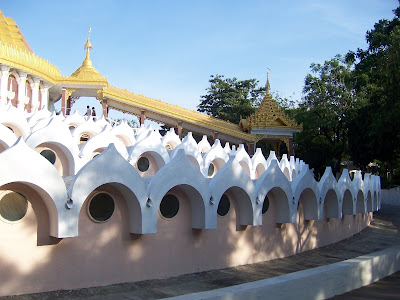
(Individual Cells for Meditation around the main Pagoda)

At the beginning of the course, we take the five precepts as given by the Buddha to householders: to refrain from killing, to refrain from stealing, to refrain from telling lies (one of the reasons for the Noble Silence), to refrain from sexual misconduct (which involves the maintenance of complete celibacy for the duration of the course), and to refrain from taking any intoxicants.

We start with the practice of Anapana Meditation, that is, the observation of natural breath. On the fourth day, when some concentration has been gained, we switch to the practice of Vipassana Meditation, the systematic observation of the entire mind-matter phenomenon through the medium of bodily sensations. On the last full day, we practice Metta-bhavana, that is, loving kindness, or sharing with others the merits we have gained.


Important aspects of the practice during the course

Noble Silence – (means silence of body, speech and mind) one abstains completely from communication with others whether vocally, or physically by glances or gestures. By doing so one becomes capable of approaching mental silence.

Adhitthana – (means strong determination) to sit in a comfortable position of your choice for a full hour, observing sensations and remaining equanimous with a strong determination that you are not going to open your eyes, hands and feet.

Awareness and Equanimity – They are like the two wings of a bird. They should be equal in size and strength, otherwise it can not fly. In Vipassana is the same, being aware and equanimous should be the same in size and strength, otherwise it won’t work.


If you want to do a 10 day course of Vipassana Meditation you can get all information you need and make the reservation online at http://www.vri.dhamma.org/

That's it for now. You can write to me if you want more details and tips for the course. Take care.

Saturday, April 30, 2011

Yoga Teacher Training Course (TTC 240 hours) - Chiang Mai - Thailand

Dear friends & Yoga enthusiasts,

Following updated information for our
Yoga Teacher Training Course in Chiang Mai.


Regular fee: USD 3,600 (Original price) 

For 1st Batch: From 4th June to 2nd July 2011

Discounted fee : USD 2,600
- (For accomodation in twin sharing)
Discounted fee : USD 2,990
- (For accomodation in single room)
(1st Batch is in progress)

Register now for 2nd Batch: From 14th July to 9th August 2011
Discounted fee : USD 2,200 (Best deal)
- (For accomodation in twin sharing - before 1st July)
Discounted fee : USD 2,600
- (For accomodation in single room - before 1st July)


(Registration open)

Regular fee : USD 3,600
- (For bookings after 1st July 2011)

- Fees include Tuition, Accommodation, Meals & Course Material.
- Please fill in the application form and make
on-line payment to reserve your place.
- Fees DO NOT include Flight Tickets

Please visit our Course Website for more information
and Online Registration:

Please make your book in advance so to guarantee your best choice !!
Namaskar !!

Tuesday, April 26, 2011

The Middling Stages of Meditation – Part 3


In Mahayana Buddhism the aim of all efforts is not only to attain Self-Liberation, but to do so in order to help other sentient beings to rid themselves from suffering and cyclic existence, in other words, to help them to achieve liberation too. This is known as the ideal of the Bodhisattva.

In this line: “Bodhicitta is a ‘mental consciousness’ which is the entry way to the Mahayana path and is concomitant with its assistant aspiration that focuses on complete enlightenment for the benefit of others.”

Bodhicitta is of two types: conventional and ultimate. Conventional Bodhicitta is the cultivation of the initial thought that aspires to attain unsurpassable and perfectly consummated Buddhahood in order to benefit all wandering sentient beings. The ultimate bodhicitta is transcendental and free from all elaborations. It is extremely clear, the object of the ultimate, stainless, unwavering, like a butter lamp undisturbed by the wind.
This is achieved through constant and respectful familiarity with the Yoga of Calm Abiding Meditation and Special Insight over a long period of time.

Calm Abiding & Insight Meditation

It is very important to understand that:

“Yogis cannot eliminate mental obscurations merely by familiarizing themselves with calm abiding (Shamata) meditation alone. It will only suppress the disturbing emotions and delusions temporarily. Without the light of wisdom, the latent potential of the disturbing emotions cannot be thoroughly destroyed, and therefore their complete destruction will not be possible.”

For this reason, the Unraveling of the Thought Sutras says:

‘Concentration can suppress the disturbing emotions properly and the wisdom can thoroughly destroy their latent potential’.

The Unraveling of the Thought Sutras also says:

“Even if you meditate with
single-pointed concentration
You will not destroy the
misconception of the Self
And your disturbing emotions
will disturb you again;
This is like Udrak’s single-pointed meditation.

When the selflessness of
phenomena is examined specifically,
And meditation are performed
on the basis of that analysis,
That is the cause of the resultant liberation;
No other cause can bring peace.”

For this reasons, those who wish to attain the thoroughly purified transcendent wisdom by eliminating all obscurations should meditate on wisdom while remaining in calm abiding meditation.

The Heap of Jewels Sutra says:

“Single-pointed concentration is achieved by adhering to moral ethics. With the achievement of single-pointed concentration, you meditate on wisdom. Wisdom helps you to attain a pure pristine awareness. Through pure pristine awareness your moral conduct is perfected.”

A Yogi’s mind will be distracted to various objects if he cultivates only special insight without meditating on a calmly abiding mind. It will be unstable like a butter lamp in the wind. Due to the power of calm abiding meditation, the mind will not be disturbed by the wind of conceptual thoughts (... and) special insight eliminates every stain of wrong views.

The Moon Lamp Sutra says:

“By the force of calm abiding meditation, the mind will become unwavering, and with insight it will become like a mountain.”

Therefore, maintain a Yogic practice of them both.

Initially the Yogi should seek the prerequisites that can assist him in actualizing calm abiding meditation and special insight quickly and easily. So we’ll see those in the next post.

Namaskar !!

Tuesday, March 29, 2011

International Yoga Teacher Training 2011 (YTT) in Chiang Mai, Thailand

Namaste freinds, With the blessings of our Gurus, Smt. Hansaji Jaydeva Yogendra and Dr. Jayadev Yogendra and all other respected teachers who have imparted the precious knowledge of Yoga to us, we have established our Yoga Academy. WLYA is the acronym for Wise Living Yoga Academy in what is an educational body which imparts Yoga Education and Lifestyle Principles of Classical Yoga. Daniel and I (Jeenal) have trained hundreds of International students and probably more than a thousand of Indians in the Yoga Teacher's Training Course from the Yoga Institute of Santacruz, Mumbai which is the Oldest Organisation of Yoga in the world. We have been also actively training several people with health problems,corporates thousand of children from different backgrounds and many different Yoga projects. Last year we got an authorisation and affiliation certificate from our Gurus Hansaji and Dr. Jayadev who are the directors of the Institute to form our Academy and give certificates. So now our Academy is affiliated to the Yoga Institute.

Daniel & Jeenal with Smt. Hansaji Jayadeva Yogendra at The Yoga Institute of Santacruz, Mumbai, India.

Daniel and I have been working since past years teaching and working in setting a favorable Yoga Syllabus for International students. So now we have come up with our 240 hours of Yoga Teacher's Training Course which matches the International standards of Yoga Certifcation Programs as well. The other great advantage is that they also get certified from us and we are affiliated to the Yoga Institute of Mumbai, India as the world's oldest Yoga School. Our course is very comprehensive, with structured syllabus and assesement and it covers important aspects of Yoga ideology, philosphy, history and background. I can say that it aims at transforming one's life and it is even very good for anybody looking for a positive change in one's life at physical, emotional and spiritual levels. The course is from 4th June to 2nd July 2011. The weather is going to be warm with sunny bright days with occasional showers sometimes.


You can visit our Yoga TTC website: http://www.teachertraining.wiselivingyoga.com/

For more information you can also visit our main website: http://www.wiselivingyoga.com/


The reason we have selected Chiang Mai, Thailand is because of a very nice guest house which is favourable for training. It has a very nice covered rooftop and the accomodation is lovely, comfortable and quite with good facilities. Also Chiang Mai is a beautiful, traditional and International tourist destination which attracts thousand of tourists. So ofcourse there are days off for sightseeing as well ;-)

So you all are welcome to learn, share, explore and absorb the ancient knowledge of Yoga and life, so we all together can bring wisdom and compassion in our lives and in the lives of others as a Yoga Teacher, or a Yoga Instructor, or just being a kind person . Right now we are practicing and updating our Yoga knowledge in the Himalayas and busy preparing for the course to give you all the best we can.

Much Peace and Light,

Namaskar,

Jeenal

Saturday, March 26, 2011

Ahimsa - Non-violence

Yesterday while passing by the village of Naddi I caressed the tender calf who was probably a few days old. I felt a deep connection.


After a while, sitting in the green grass I saw two little..very little bright red bugs with black spots mating. I felt love for them. And in the twilight of the evening, while sitting on the rooftop facing the Himalayas, just below in the courtyard of the villagers house, I saw the mother goat tied with a rope while the little black lamb was free. As the baby lamb would go around a few meters away to explore, the mother goat would attentively and protectively observe the baby. The baby lamb would come hopping back to the mother with a sense of achievement, and the mother goat would lick her baby with love. I thought, this is how all the mothers are, full of loving tenderness..isn't it?

Ahimsa or Non-violence is the first Universal Ethic, one of the first Yama of the Patanjali Ashtanga Yoga, also know as the eight-fold path of Yoga.
The highest moral conduct for a human being is the practice of Non-violence. When we are able to connect closely to all the living beings, be it an animal..big or small, a tiny fish, or a worm, we will realize that they all are seeking for happiness and the wish to live without pain or suffering. Just as you do, just as we all do. We genuinely wish happiness for all the beings when we are able to feel their pain and feel compassionate love towards them. This is the highest path of humanity and the only way towards self- realisation and God. May all beings be happy !!!
Namaskar !!!
With love, Jeenal.

Friday, March 18, 2011

The Middling Stages of Meditation - Part 2

Meditating on Compassion

Before beginning meditation proper one can prepare oneself by cultivating suitable mental states. Suitable states are those which bring calm and peace to the mind and help one to achieve a balanced stated. So the instruction to meditate o compassion is given. Here the word “meditate” should be understood more like “contemplate” or to “think about”. How to do it:


The Outset

Developing Equanimity


“Begin the practice by meditating on equanimity. Try to actualize impartiality towards all sentient beings by eliminating attachment and hatred. […] Begin the meditation on equanimity by thinking of a neutral person and then consider people who are friends and foes. After the mind has develop equanimity towards all sentient beings meditate on loving-kindness. Moisten the mental continuum with the water of loving-kindness and prepare it as you would a piece of fertile ground. When the seed of compassion is planted in such a mind, germination will be swift, proper and complete. Once you have irrigated the mind stream with loving-kindness, meditate on compassion”.

The idea here is to understand how all sentient being are looking forward to be happy and trying to avoid suffering. The feeling of equanimity here is developed when one thinks deeply on how in this beginningless cycle of existence, there is not one sentient being who has not been one’s friend or relative hundreds of times. If one takes this perspective there is no ground for being attached to some and hating others. So one thinks:
“I shall develop a mind of equanimity towards all sentient beings”.


The compassionate mind has the nature of wishing all suffering beings to be free from suffering, so with the base of an equanimous mind one is advised to meditate on compassion for all sentient beings which experience all types of pains and sufferings. Animals suffer from hunger and thirst and experience immense physical suffering: they eat each other, become angry, and are hurt and killed. The human beings too experience various types of suffering:


“Not being able to find what they want, they are resentful and harm each other. They suffer the pain of losing the beautiful things they want and confronting the ugly things they do not want, as well as pain of poverty. There are those whose minds are bound by various fetters of disturbing emotions like craving desire. Others are in turmoil with different types of wrong views. These are all cause of misery, therefore they are only in intense pain like being on a precipice. […] Pervasive misery is what arises under the power of causes characterized by actions and disturbing emotions. It has the nature and characteristics of momentary disintegration and pervades all wandering beings”.


The advice is that whether you are engaged in one-pointed meditation or pursuing your ordinary activities, meditate on compassion at all times, focusing on all sentient beings and wishing that they all be free from suffering.

Developing Loving-kindness

“Begin by meditating on your friends and relatives. Recognize how they experience the various sufferings that have been explained. Then having seen all sentient beings as equals with no difference between them, you should meditate on sentient beings to whom you are indifferent. When the compassion your feel towards them is the same as you feel towards your friends and relatives, meditate on compassion for all sentient beings throughout the ten directions of the universe”.

“Meditation on loving-kindness begins with friends and people you are fond of. It has the nature of wishing that they meet with happiness. Gradually extend the meditation to include strangers and even your enimies. Habituating yourself with compassion you will gradually generate a spontaneous with to liberate all sentient beings. Therefore, having familiarized yourself with compassion as the basis, meditate on the awakening mind of bodhichitta”.

This is getting interesting, isn't it? We shall continue in the next post.
Have a try with this technique and then let me know your comments, please.

Namaskar!!!

Monday, March 14, 2011

The Middling Stages of Meditation - Part 1

I and Jeenal are in Mcleod Ganj/Dharamshala since past two weeks. For those who don’t know, Mcleod Ganj is the residence of his holiness the Dalai Lama and the headquarter of the Tibetan Government in exile.

After submitting an application form and getting a teaching pass few days ago, we were blessed today to attend the lecture of the Dalai Lama in the temple complex. We saw him passing nearby while coming inside the temple. We set just outside the main hall where he was to deliver his lecture.
He started by presenting in brief the main tenets of the Buddha’s teachings:

From the Dhammapada:
“Commit no evils; engage in virtuous deeds; subdue one’s mind thoroughly. This is the teaching of the enlighten one.”
This short verse can be considered to have the essence of all the teachings of the Buddha.
He then proceeded by explaining in short the way out of suffering. The path to liberation as taught by the Buddha is also known as The Noble Eight-fold Path divided in three sets of practices: the practice of morality; the practice of concentration; and/leading to the cultivation of wisdom (thought insight meditation).
At the request of his students he was then discussing on a scripture about The Middling Stages of Meditation. A bit of it I’ll introduce to you here:
“It is not possible for omniscience to be produced without causes, […] from among these causes and conditions, you should cultivate correct and complete causes. If you put the wrong causes into practice, even if you work hard for a long time, the desired goal cannot be achieved. It will be like milking a (cow’s) horn. Likewise, the result will not be produced when all the causes are not put into effect. […] Therefore, those who desire a particular result should cultivate its complete and unmistaken causes and conditions.”
This is a warning to people who think that one can practice meditation without a previous preparation. So this is especially pertinent regarding the practice of Yamas and Niyamas in Yoga.
In the context of the Buddha teachings and as per the system of Mahayana Sutras the following is presented:
"Therefore, if you are interested in achieving omsniscience, you need to practice these three: compassion, the awakening mind of bodhichitta and skillful means.”
On compassion
With reference to the Boddhisattvas, who moved by compassion take the vow to liberate all sentient beings, the practice of compassion is exalted:
“Having entered into this practice they will certainly complete the collection of merits and insights. Accomplishing the accumulation of merit and insight is like having omniscience itself in the palm of your hand There, since compassion is the only root of omniscience, you should become familiar with this practice from the very beginning.”
The Buddhisattvas have already achieved all their own goals, but remain in the cycle of existence for as long as there are sentient beings. This is because they possess great compassion. Therefore, great compassion alone is the unavoidable cause of the non-abiding nirvana of a Buddha.
How to meditate on compassion and how to proceed further I’ll share in my next post.
Till then.. Namaskar !!